Construction Market Trends
Winter 2026
Uneven Momentum as Construction Begins a New Year
Steve Stouthamer
Executive Vice President, Project Planning
Skanska USA Building
Supply Chain
Industry Indices
Forecast
Webinar Series
Email Steve
Construction
Winter 2025
Supply Chain.
Escalation Forecast.
Industry Indices.
Market Trends Report
Escalation Forecasts
Our Strategic Supply Chain Team maintains relationships with manufacturers and is closely monitoring the impact of tariffs on the supply chain.
Tariffs
As we enter 2026, the U.S. construction market remains in a period of cautious transition. After growth in 2023 and 2024, persistent labor shortages, tariff uncertainty and elevated construction costs moderated activity in 2025. Broad spending was down and backlogs slipped for many small contractors. Following that contraction, the industry’s macro trends remain modest for the new year. Consensus forecasts point to slight gains in total construction spending in 2026—flat to low single-digit growth—as private investment remains cautious, and economic and policy uncertainty persist. High borrowing costs and increasingly selective lending standards continue to temper residential and traditional commercial project starts, while policy and public investment help sustain infrastructure projects. Sector performance is highly uneven. The standout growth drivers are data centers and large tech-related megaprojects, powered by ongoing demand for AI, cloud and data infrastructure. The large amounts of capital these projects attract are sustaining the engineering and construction pipeline. Institutional construction—particularly healthcare, education and public facilities—are also projected to outpace broader nonresidential activity. By contrast, traditional residential construction and cyclical commercial segments, such as retail, office and manufacturing facilities, are softer. Multifamily housing still faces pressure from high mortgage rates and affordability challenges, and retail and office projects have slowed following pre-pandemic-era peaks. Recovery in housing and these private sectors is likely to be gradual, hinging on further interest rate reductions, improved consumer demand and reduced input costs. More optimal conditions may not materialize fully until 2027, but even that is highly speculative.
While the U.S. engages with countries to work on improved trade agreements, the following tariffs remain in effect: The U.S., Mexico, Canada trade agreement (USMCA) from the first Trump administration remains in effect, exempting many products traded between the three countries, including many construction products, from further tariffs. In our March webinar, we projected that tariffs at the time could increase commercial construction project costs by +/- 5 percent. With early April’s tariff escalations, we felt that range could potentially double, but fortunately many of those higher tariff ranges have been paused to potentially allow for trade negotiations to continue. The cost of construction rose considerably post-pandemic, and additional tariffs would only challenge budgets further. These pressures could reduce construction spending, partially offsetting increased costs but also creating employment and recessionary concerns. As we monitor further tariff policy changes and shifts and reductions in federal investment spending, below are some potential risk mitigation strategies.
The USMCA is very important considering the volume of construction materials that pass between the three countries. We urge suppliers to continue to seek inclusion of products not currently covered by the agreement to mitigate tariff duties. Be flexible with the specification of construction materials for projects. It may be possible to onshore the same or comparable products that are not currently subject to tariffs. Monitor developments in tariffs and trade negotiations. As we do with our Strategic Supply Chain Team, go deeper into your supply chains to understand what manufacturers are doing to mitigate tariff risks. Partner with manufacturers who have been able to pivot and deliver in the most economical manner.
Contact us for more detailed, up-to-date information
Our Strategic Supply Chain team and our guests from Steel and Aluminum industries will be covering the impacts of tariffs on our upcoming Webinar. Register here
Next Page
Keep scrolling to read our full analysis on the impending impacts
How to prepare:
Winter Market Trends Report published: February 10, 2026
25%
30%
10%
tariff on all steel and aluminum, as well as their derivative products
tariff on all Chinese imports (down from 145% based on 90 day pause as of 5/12/25)
universal tariff on all foreign imports
Current Tariffs Implemented by the U.S.
Current Tariffs Implemented by the U.S. Impacting the Construction Industry
14.5%
tariff on all Canadian lumber
Canada
All Goods
Lumber
USMCA
35%
35.2%
—
China
30-47%*
Mexico
Materials
Steel
Aluminum
50%
Copper
Tariff rate depends on the type of product being imported.
Given the current uncertainties and labor shortages as well as new construction opportunities, please join us for Skanska’s Market Trends Webinar for innovative, adaptive strategies to build faster, safer and smarter.
Analysis
Indices
Webinar
Contact
Register for Webinar
Global steel tariffs continue to drive price increases by domestic mills. Prices have increased throughout 2025 and into 2026, while capacity utilization has remained steady, hovering around 76 percent. A new dynamic appears to be emerging in the market. With data centers, large factory and semiconductor manufacturing construction projects going strong, many large steel fabricators are booked out through the latter part of 2026. The capacity of these fabricators is becoming a supply chain constraint and is driving the overall lead time. In addition, with the steady upward march of domestic steel pricing, overseas pricing—and potentially more competitive lead times—are starting to look attractive to fabricators. In reaction to aluminum tariffs, the Premium Duty Paid U.S. Midwest has increased from roughly $500/tonne in January of 2025 to $2,200/tonne today. The Premium Duty Paid measures the difference in price between LME price levels outside of the U.S. against the price when delivered within the U.S. This is driving costs up for major users of aluminum, like curtain wall providers, prompting many to announce price increases.
All Goods: IEEPA Section 122
30-47%* 10%*
Section 301 remains in place
25% 10%*
35% 10%*
Materials (Section 232)
7.5-25%
Tariff Update This report was originally published on February 10, 2026. The tariff dashboard below has been updated to reflect current tariff rates after the Supreme Court’s ruling on the International Emergency Economic Powers Act (IEEPA) and the Trump administration’s subsequent announcement of a global 10-percent tariff.
Softwood Lumber
Section 122
All goods not subject to section 232 tariffs 15% threatened, time bounded at 150 days
10%*
New
Winter 2026 Supply Chain
Source: U.S. Energy Information Administration, January 2026
Source: Engineering News-Record, January 2026 U.S. Bureau of Labor and Statistics and Producer Price Index, Drywall and Gypsum, January 2026
Source: Steel Benchmarker, January 2026
Source: U.S. Bureau of Labor and Statistics Producer Price Index, January 2026
Source: Engineering News-Record, January 2026 U.S. Bureau of Labor and Statistics Producer Price Index, January 2026
Generators
HVAC Equipment
Electrical Gear
Fuels and Natural Gas
Piping
Structural Steel Inputs
Concrete and Cement
Gypsum and Metal Studs
Lumber and Wood
Metals
Status Key
Trending Up Significantly
Trending Up
Fluctuating
Trending Down
Stable/Consistent
Previous Page
- Overall, metals pricing is up from mid-year. - However, the rally caused by China’s stimulus program at the end of September proved to be short-lived, and pricing has since settled down.
Source: Kitco All data as of October 2024
Material
Ceilings, drywall, metal studs, flooring, paint, etc.
Current Status:
Lead Time
6-12 Month Forecast:
Price
Concrete pricing is up modestly at the start of 2026. We will be monitoring the rising price of structural steel and the potential shifts it causes toward more concrete structures, which could boost demand and pricing.
Source: Engineering News-Record, January 2026 and U.S. Bureau of Labor and Statistics Producer Price Index, January 2026
No recent drywall price increases have been announced, and drywall pricing remains flat as residential demand remains muted. In response to continued upward movement in the coiled steel market, major steel stud manufacturers have announced price increases in January or February.
Lumber pricing rose modestly at the end of 2025 due to lumber mill curtailments. However, pricing is expected to moderate coming into the new year as housing starts remain below healthy levels.
Metals pricing is rising in nearly all categories. Major drivers are electrification, AI and speculative buying brought on by geopolitical uncertainty. At the same time, inventory of some metals is growing. This could help to keep pricing in check.
Source: Kitco, January 2026
The price of fuel (regular unleaded gasoline) remains close to its three-year low. This is primarily due to a combination of lower crude oil prices, high domestic production and weakened demand. Natural gas pricing is near a three-year high, but still down considerably from 2022’s peak pricing that resulted from the Russian invasion of Ukraine.
PVC: Soft residential demand and low oil prices continue to keep PVC pipe prices down. Copper Piping: All-time high copper pricing continues to push pipe prices up. Carbon Steel: Carbon steel pipe prices are stable despite steel tariffs.
Structural steel price increases are growing; the cost of wide flange has increased $100/ton since October. Strong demand from data centers and large factories are straining mill and large fabricator capacity, increasing lead times to 18–30 weeks.
Structural Steel
Lead times for electrical gear are trending down; manufacturers have invested in factory expansions and outsourcing to increase production capacity. Lead times do remain elevated for switchgear, switchboards, ATS and liquid-filled, pad-mounted transformers. Lead times on specific equipment vary greatly depending on the manufacturer. Prices in 2026 are again expected to rise 8–10 percent due to strong demand, tariffs and metal price increases.
Source: FRED, December 2025
Demand for data center gensets (>2MW) remains very strong. Lead times have stabilized: 1MW to 2MW gensets are between 75–120 weeks; 250kw to 1MW range from 30–35 weeks; below 350kW are stable at 18–30 weeks. Actual lead times vary depending on the manufacturer and specifications. Prices in 2026 are expected to increase 5–8 percent.
Lead times for HVAC equipment continue to trend down for most equipment categories. Price increases in 2026 are expected to be less than in 2025 but can range from 8–10 percent, depending on the manufacturer.
Insulation
Insulation pricing has flattened out. There were no price increases announced at the end of 2025, and none are expected during Q1 2026.
Source: U.S. Bureau of Labor and Statistics, January 2026
Supply Chain Analysis
The answer, in a word, is metals. Metals pricing is experiencing inflation in nearly every category. The combination of tariffs, constrained supply and increasing demand is driving prices higher. Here are some examples of what we are seeing: Steel HRC/CRC prices continueing to rise and areis up nearly 45 percent% since mid-2025. This is driving up the cost of metal studs. Major stud manufacturers have announced increases of 10–15 percent, effective in January, in addition to previous increases that were implemented in November. In addition, structural steel pricing is also on the rise. Wide flange pricing is up $100/ton from October 2025. The combination of tariffs and strong demand from data centers and manufacturing facilities are key factors driving up prices. Copper Futures are trading at an all-time high, topping out above $6/lb. in early January. Pricing has retreated slightly as global inventories have risen, especially in China. However, demand remains strong as the shift towards electrification, renewable energy and artificial intelligence continues. Copper wire pricing is up 25–30 percent from January 2025. Aluminum Tariff impacts have been more pronounced in this category, due partly to the fact that the U.S. produces less aluminum than other metals. While nearly 80 percent of steel utilized in the U.S. is produced domestically, less than 50 percent of aluminum is. The Midwest Premium has grown from $500/tonne to $2,200/tonne, which led several curtain wall manufacturers to announce price increases in 2025 and then again at the start of 2026. In addition, aluminum wire pricing is up nearly 20 percent. Further inflation of metals pricing will depend heavily on domestic and international demand. China is a major consumer of metals and is currently experiencing a significant downturn in their real estate market, which has so far prevented higher levels of inflation. Should economic activity pick up, we expect to see even more inflationary pressure in the metals markets. Speculative buying of some metals (gold, silver and copper) has also surged in early 2026, further driving metals pricing inflation.
Greatest threats to supply chain stability:
HVAC equipment, electrical gear, steel, elevators and curtain wall will be impacted by the 10-percent tariff on all Chinese goods, as well as the 25-percent tariff on all imported aluminum and steel. Additional categories, such as finished goods, lumber, drywall, fixtures, and other material, may be affected by potential duties in March.
Immigration
Labor markets in the U.S. remain tight given the low unemployment rate. Slowing immigration and increased deportation of undocumented workers may exacerbate the construction and manufacturing labor markets.
Recent disasters, including Hurricane Helene in the Southeast and the wildfires in Southern California, will likely have significant impacts to their regional construction supply chain.
There remains uncertainty around the wars in Ukraine and the Middle East, as well as the potential for further conflict related to Taiwan and North Korea.
Our Strategic Supply Chain Team is closely monitoring the impact of weather related disasters and geopolitical events on the supply chain.
2MW+
What to watch in 2026?
Drywall and Gypsum
Summer 2025 Supply Chain
Download Report
Crude Oil Unleaded Fuel Diesel Natural Gas
Current Price
Steel HRC/CRC prices continue to rise and are up nearly 45 percent since mid-2025. This is driving up the cost of metal studs. Major stud manufacturers have announced increases of 10–15 percent, effective in January, in addition to previous increases that were implemented in November. Structural steel pricing is also on the rise. Wide flange pricing is up $100/ton from October 2025. The combination of tariffs and strong demand from data centers and manufacturing facilities are key factors driving up prices. Copper Futures are trading at an all-time high, topping out above $6/pound in early January. Pricing has retreated slightly as global inventories have risen, especially in China. However, demand remains strong as the shift towards electrification, renewable energy and artificial intelligence continues. Copper wire pricing is up 25–30 percent from January 2025. Aluminum Tariff impacts have been more pronounced in this category, due partly to the fact that the U.S. produces less aluminum than other metals. While nearly 80 percent of steel utilized in the U.S. is produced domestically, less than 50 percent of aluminum is. The Midwest Premium has grown from $500/tonne to $2,200/tonne, which led several curtain wall manufacturers to announce price increases in 2025 and then again at the start of 2026. In addition, aluminum wire pricing is up nearly 20 percent. Further inflation of metals pricing will depend heavily on domestic and international demand. China is a major consumer of metals and is currently experiencing a significant downturn in their real estate market, which has so far prevented higher levels of inflation. Should economic activity pick up, we expect to see even more inflationary pressure in the metals markets. Speculative buying of some metals (gold, silver and copper) has also surged in early 2026, further driving metals pricing inflation.
The answer, in a word, is metals. Metals pricing is experiencing inflation in nearly every category. The combination of tariffs, constrained supply and increasing demand is driving prices higher.
Gypsum Metal Studs
Winter 2026 Indices
Materials and Commodities
Drywall, Gypsum and Insulation
Market Sentiment
Home
Pricing
Forecast Map
Contact Us
Construction Cost Indices
Spending
Building Cost Index
Materials Index
U.S. Employment
Labor
Architecture
Unemployment
Click an index or material to view details
Winter 2025 Construction Pricing Snapshot
The ENR Materials Index continues to cool from the significant year-over-year inflation experienced in 2021 and 2022. Like the BCI and CCI, the Materials Index doesn’t include mechanical and electrical equipment cost impacts, which have driven project costs higher than traditional measures of construction inflation. With the large volume of high-tech work and expanding electrification efforts in service of decarbonization, such equipment costs will remain high.
Source: Engineering News-Record Data as of November 2024
Use this slider to modify the timeframe of the data shown on the graph. Click on the graph for specific pricing data points.
Source: U.S. Bureau of Labor Statistics All data as of October 2024
Hover over the chart to see exact figures
The unemployment rate sits at 4.1 percent as of October 2024, down from a high of 4.3 in July 2024. Total nonfarm payroll employment experienced a slowdown in growth in October with only 12,000 additional jobs added. This is attributed to the decrease in manufacturing employment due to labor strikes and offsetting growth in healthcare jobs. Construction only had a minor increase of 8,000 jobs from September to October, keeping the unemployment rate steady.
U.S. Unemployment
For the past 12 months, both of ENR’s core construction indices have remained below the 3–3.5 percent historical, annualized escalation trend. However, it’s important to remember that regional locations are experiencing inflation differently based on work volume. MEP system costs, which are not incorporated in the ENR indices, continue to escalate more rapidly than other building systems.
Source: U.S. Census Bureau and Dodge Data & Analytics Construction spending data for September 2024 and Dodge Momentum data is from September 2024
While the Dodge Momentum Index decreased 4.2 percent from August to September, the index remains at “very robust levels,” up 21 percent from September 2023. In September 2024 alone, 28 projects valued at $100 million or more entered the planning stage. Per Sarah Martin, associate director of forecasting at Dodge Construction Network, “A surge in data center activity drove much of the recent rapid growth in the DMI...By mid-2025, the Fed’s rate cuts should spur planning projects to reach groundbreaking more quickly.”
Construction Spending and Dodge Momentum Index
Might Change
Source: Engineering News-Record All data as of November 2024
Skilled Labor Index and Common Labor Index
ENR's craft labor indices have had year-over-year increases under 1.8 percent. The 10-year average annual increases for these indices are in the 2–2.5 percent range. However, because they do not factor in mechanical and electrical (M/E) crafts, these indices can be misleading and may underestimate labor cost escalation. A similar 10-year trend for M/E labor has shown a 4.2 percent increase per year. Given the mix of trades on construction projects, we estimate that the annual craft labor increase for the past 12 months is in the 2.5–3 percent range.
Skilled Labor and Common Labor Indices
Source: AIA, All data as of September 2024
The Architecture Billings Index remains below 50, as the majority of firms continue to report a decline in billings. Conditions remain soft in all regions of the U.S., with firms in the South reporting the strongest ABI at 49.5. However, the pace of decline seems to have subsided, and conditions may turn positive soon given the lowering of interest rates by the Fed in September.
September ABI Report
Architecture Billings Index
This Architecture Billings Index (ABI) demonstrates whether or not architectural firms are billing for or signing new design contracts. The construction industry feels the impact of this index with a 9-to-12-month lag time.
Scoring
-50: decrease in volume =50: neutral 50+: increase in volume
The drop in prices over the past 60 days is driven in part by sluggish demand for gas as the busy summer traveling season has given way to an autumn slowdown. Meanwhile, a sharp decline in the price of crude oil has propelled a larger drop-off in gas prices than is typically seen at this time of year.
Source: U.S. Energy Information Administration All data as of October 2024
Source: Engineering News-Record and U.S. Bureau of Labor and Statistics data as of October 2024 and Producer Price Index data as of September 2024 Drywall and Insulation data as of October 2024, Gypsum data as of October 2024
Drywall availability and pricing are stable. Insulation prices are stable in the short term but an increase in new home sales could apply upward pressure. Lead times for mineral wool insulation remain elevated but have receded slightly from 30 weeks down to 20 weeks.
Source: Engineering News-Record and U.S. Bureau of Labor and Statistics Producer Price Index Concrete Block and Precast Concrete data as of September 2024 4000 PSI data as of September 2024
Concrete pricing continues to rise but at a slower pace than 2023. Quarter to quarter, 4000 PSI concrete pricing is up just 0.6 percent.
Source: Steel Benchmarker All data as of October 2024
Structural steel pricing fluctuates from week to week, but the overall trend since the start of 2024 has been downward. Plate steel, the most significant component in building structural steel, has been a key reason for lower fabricated steel pricing.
PVC: PVC pipe prices are down due to low residential demand and a solid supply of resin. Copper: Raw copper prices have been volatile. However, pipe costs have remained relatively flat since last quarter. Ductile Iron Pipe: Prices have been relatively stable over the last six months due to flat demand.
Source: U.S. Bureau of Labor and Statistics Producer Price Index All data as of September 2024
Lumber pricing continues to be soft due to weak demand. Housing starts remain low at 1.35 million for the month of September, down from 1.36 million in August.
Source: Engineering News-Record and U.S. Bureau of Labor and Statistics Producer Price Index Plywood and 2x4 S4S data as of October 2024 Lumber and Plywoo4d data as of October 2024
Overall, metals pricing is up from mid-year. However, the rally caused by China’s stimulus program at the end of September proved to be short-lived, and pricing has since settled down.
Dodge Starts and Momentum Index
Architectural Billings Index
Employment Rates
ENR Building and Construction Cost Indices
Composite Cost Index
Construction Spending
Index
The 12 months ending February 1 saw the CCI move up 2.7 percent and the BCI move up 3.9 percent. This is more than double what these indices showed in 2024, which reflects both tariff impacts and massive growth in the tech sector. As we have previously mentioned, these indices do not include key MEP trades, which have had a higher trajectory given the tech sector growth.
Source: ENR, February 2026
MEP costs make up a significant portion of total construction costs. Using our in-house Skanska MEP expertise, we have forecasted the pace of MEP price inflation and blended this with the ENR (architectural/structural trades) indices. Our MEP data shows an annual increase of approximately 11 percent in those key trades, creating a Composite Index increase of 6.8 percent for the 12 months ending in February 2026. While each region will feel the pace of escalation differently given local volumes, our escalation forecasts for individual projects are likely more aligned with the Composite Index.
Source: Engineering News-Record and Skanska, February 2026
The ENR Materials Index is up four percent for the 12-month period ending February 2026, compared to an increase of 2.4 percent for the same time period a year ago. This is a modest increase given the tariffs imposed in 2025. Many industry materials providers have mitigated tariffs through adjustments in supply chains and onshoring to lessen the impact on material pricing for the year. Court decisions are still pending on the legalities of various tariffs, which will likely impact material pricing in 2026. The ENR Materials Index does not include mechanical and electrical material, which has escalated at a more significant pace.
Source: Engineering News-Record, February 2026
Total construction starts were up 2.6 percent in December 2025 to a seasonally adjusted annual rate of $1.24 trillion. This growth was driven by a 16.3-percent increase in nonbuilding starts, with substantial gains in highways and bridges and miscellaneous nonbuilding projects. Alternatively, nonresidential starts declined 6.6 percent due to drops across manufacturing, education and other institutional market sectors. However, data centers, garages and hotels continued to show strong month-over-month growth. Year over year, nonresidential building starts are up four percent by dollar volume but are down about six percent by square footage. The Dodge Momentum Index grew 7.0 percent from November to December. Commercial planning was up 3.5 percent, driven by warehouses, office buildings and data centers. Institutional planning was up 14.9 percent, with growth in education and recreational buildings. Year over year, the Dodge Momentum Index was up 50 percent, with institutional planning up 60 percent and commercial planning up 45 percent—though that drops to 30 percent when excluding data centers. Nonresidential construction will accelerate in 2027 due to sustained planning across 2025 in data center, healthcare and recreation markets.
Source: Dodge Data & Analytics, December 2025
Total construction spending in October 2025 totaled $2,175 billion—0.5 percent higher than the previous month, but 1.0 percent below the same period in 2024. Private and residential construction increased by 0.6 percent and 1.3 percent, respectively, while nonresidential construction decreased by 0.2 percent from September to October 2025. Public and education sector construction spending increased by 0.1 percent and 0.7 percent, respectively. Construction spending from January to October 2025 was 1.4 percent below the same time period in 2024.
The Architecture Billings Index is still in decline, with a score of 48.5 in December. The Index remained below the desired threshold of 50 (a score below 50 indicates declining firm billings) in every month of 2025, indicating a weaker market for architectural billings. Design inquiries remain weak, and the value of new design contracts continued to decrease. Multifamily residential markets marked the softest billings, and institutional was only modestly in decline. Firms in the West, South and Northeast are still in decline. However, Midwest firms experienced increases from August to December. Despite all this, backlogs remain strong at 6.3 months.
Architectural Billing Index
In December, the construction industry lost 11,000 jobs, netting only 14,000 jobs added across 2025 for a minimal increase of 0.2 percent. The industry’s unemployment rate is down 0.2 percent from December 2024. ABC Chief Economist Anirban Basu notes: “This unusual dynamic—decreasing employment but a steady unemployment rate—likely reflects the effects of immigration policy on the industry’s workforce.” The national unemployment rate remained relatively flat in December, with a 4.4-percent unemployment rate and only 50,000 jobs added.
Source: U.S. Bureau of Labor Statistics, December 2025
Employment
Dodge Momentum Index
Construction Starts Index
Composite Construction Cost Index
ENR Construction Cost Index
Winter 2025 Indices
Source: AIA, December 2025
December ABI Report
Project Stress Index
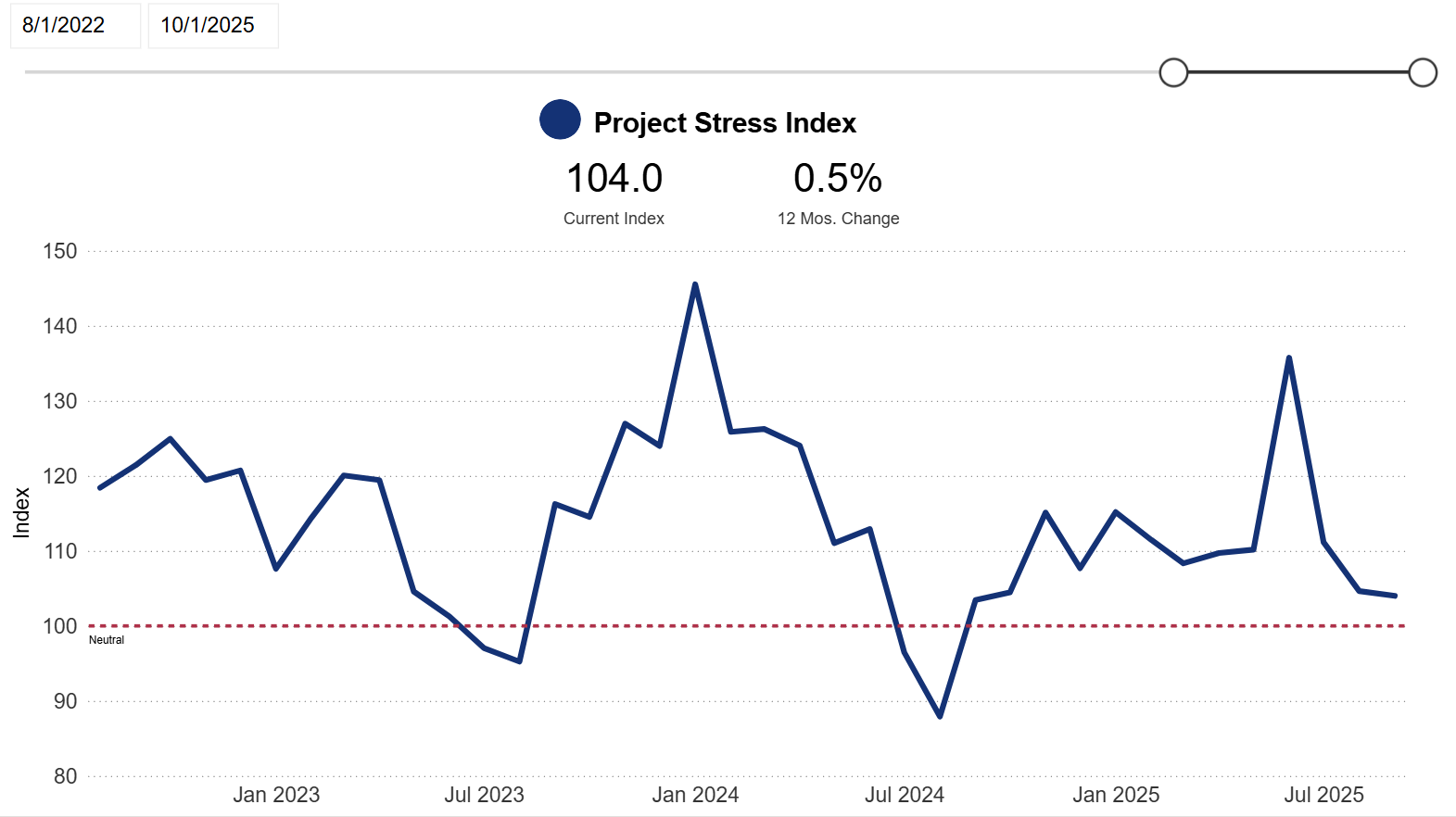
The Project Stress Index (PSI) tracks delayed bid dates, on-hold projects and abandonments in preconstruction over the past 30 days, providing an early warning system for market conditions. The PSI closed December 2025 at 102.1, marking a significant 18.7-percent month-over-month decrease from November’s reading. The overall PSI has fallen 4.3 percent compared to the same time last year, driven by a 23.2-percent decrease in on-hold activity and a 9.8-percent decrease in bid date delays. Conversely, project abandonment remains 21.1 percent higher than last year.
Source: ConstructConnect, December 2025
Placeholder 'til chart is embedded.
Forecasting Local 2026 Construction Costs
This map reflects local USA Building Project Planning Services team leaders’ opinions of market volume and capacity and is not based on published analytics or third-party forecasts.
Click the map pins to see forecast details for a specific city or region.
Miami/Ft. Lauderdale
Seattle
Portland
Orlando
Tampa
New Jersey
New York
Boston
Phoenix
Philadelphia
Washington D.C.
North Carolina/ Virginia
Cincinnati
Atlanta
Nashville
Houston
Dallas
San Antonio
Los Angeles
San Francisco
Boston/New England
The Boston construction market in early 2026 is driven by steady activity in public education, infrastructure, transportation, aviation, healthcare and institutional sectors. Life sciences work continues through tenant improvements and specialized fit outs, but large ground-up developments are rare. Regulatory requirements and Massachusetts’ specialized energy codes are shaping project scopes. Cost escalation has stabilized at around four percent annually, though competition in the bid environment is tightening margins. Long lead items pose schedule risks, and certain union trades remain labor constrained. To navigate these conditions, owners and industry partners should engage early in design and procurement, pre-purchase critical equipment, freeze key design elements promptly and consider alternate specifications to broaden supplier options. Prefabrication and modular construction can help offset labor shortages while supporting sustainability goals and regulatory compliance.
Want to discuss Boston's market position and forecast?
Early Signs of a Good Spring Crop Start to Emerge from the Winter Cold
Back to map
Atlanta, GA
Mission critical: Mission critical development is accelerating overall industry growth, but it is simultaneously intensifying demand for skilled labor and specialized subcontractors. K–12 and higher education: These sectors are expected to maintain steady activity through 2026, supported by campus improvements and facility upgrades. Future flexibility remains a key project planning concern. Infrastructure spending: Infrastructure investment is expected to strengthen through 2026, supported by Infrastructure Act funding. Challenges in this sector include policy uncertainty and labor shortages. Commercial real estate: The commercial real estate market is cautiously optimistic for the next 12 months as improving leasing activity begins to counterbalance persistently elevated vacancy rates. Residential construction: The residential construction market is steadily rebalancing on account of rising inventory, more deliberate buyer behavior and moderating—but still positive—home price appreciation.
Data Center and Mission Critical Boom Further Tightens a Strained Labor Force
Want to discuss Atlanta's market position and forecast?
Cincinnati, OH
Data centers will be a key driver for our region in the future, with over $10 billion in data center construction planned through 2032. This is in addition to an already robust construction pipeline. Higher education and K–12 projects worth several hundred million dollars are planned over the next several years, as well as numerous multifamily residential and mixed-use projects. Planning for the Cincinnati/Northern Kentucky International Airport is ongoing and includes roughly $500 million in construction work over the next 3–5 years. This busy market will continue to strain trade partner capacity and labor availability. Data centers especially will drive up labor costs and strain supply chains. For these reasons, construction cost escalation is likely to remain high for the foreseeable future.
Data Centers Driving Construction Cost
Want to discuss Cincinnati's market position and forecast?
Dallas, TX
North Texas Ranks Second in U.S. Data Center Markets
Want to discuss Dallas's market position and forecast?
Washington, D.C.
Plans for the Washington Commanders’ new football stadium look to provide a promising boost a local economy that is still slow in many markets, like commercial office and multifamily. The new 70,000-seat stadium also includes redevelopment of the entire 180-acre site, which will take place over the next 10–15 years and will include 6,000 new homes, hotels, parks and recreation, retail and outdoor amenity spaces. The higher education market is slow due to federal policy changes, funding issues and reduced enrollment. However, some counties do seem to be planning more K–12 projects. Healthcare remains steady with projects both under construction and in planning. Data center construction remains strong in northern Virginia and has expanded in other areas of Virginia and Maryland with more available power. The aviation sector outlook is still strong with major improvements planned for both Dulles and Reagan National airports.
New Stadium Development Boosts an Otherwise Sluggish Local Market
Want to discuss Washington D.C.'s market position and forecast?
Houston, TX
Houston’s construction market remains active and increasingly diversified as significant public and private capital flows into life sciences manufacturing, civic infrastructure and mixed-use development. The most notable project is Eli Lilly’s $6.5-billion biomanufacturing campus at Generation Park. Concurrently, major public investments are driving downtown and East End revitalization. Growing demand continues for multifamily and senior living, while suburban mixed-use and lifestyle centers are supported by local population growth. Skilled labor availability and cost volatility put pressure on schedules and budgets, while environmental resilience and flood mitigation remain critical considerations for both public and private projects. To mitigate these challenges, early engagement with contractors, designers and key trade partners is essential. Clients pursuing large or technically complex projects should prioritize delivery models that emphasize collaboration, early constructability input and supply chain planning.
Houston Market in a Lull, but Still Active
Want to discuss Houston's market position and forecast?
Miami/Ft. Lauderdale, FL
Sustained population growth across Miami-Dade, Broward and Palm Beach counties continues to drive long-term demand across all construction sectors. 2025 saw an increase in trade partner participation during budgeting phases which may be a sign of subcontractors looking to increase or reinforce their backlogs. Most trades are also reporting stable pricing across materials and labor, with the major exceptions being the MEP trades. Tariffs and data center construction are causing materials price escalation and longer lead times, which we should expect to continue for the foreseeable future. Project Tango, a 200-acre data center campus project making headlines in South Florida, will reportedly generate 1,000MW of capacity once completed. If approved, this project could have an outsized impact on the local market.
Data Center Construction and Tariffs Causing Price and Lead Time Instability
Nashville, TN
The Nashville construction market softened through 2025, but we are seeing encouraging signs of momentum as we move into 2026. National construction indicators—like easing interest rates, stabilizing inflationary pressures and a cooling overall U.S. construction volume—are restoring confidence for developers and investors who are ready to advance new projects. Locally, mixed use, condominium and hospitality planning activity continues to progress, while the apartment sector has paused due to market saturation. We are also seeing underutilized office buildings undergo repurposing, a trend that could create additional opportunities in the future. Looking ahead, major initiatives such as the East Bank redevelopment, Oracle’s future campus and The Bend brownfield transformation are expected to drive significant construction activity and sustain the regional pipeline.
Rebounding Confidence in Nashville’s 2026 Construction Market
Want to discuss Nashville's market position and forecast?
North Carolina/Virginia
Virginia continues to be defined by an aggressive and sustained wave of data center development, causing steel and electrical contractors to face unprecedented volume, extended mill lead times, long fabrication queues and intense labor competition. The Commonwealth also remains a magnet for high profile life sciences and research and development facilities. Outside of these two sectors, most commercial markets are showing clear signs of cooling. In North Carolina, the market is sustained by exceptionally strong healthcare and life sciences pipelines across the Triangle and Charlotte regions. Labor availability remains generally adequate, but competition is driving wage escalation. Across both states, higher education remains notably slower than historic norms, with fewer major capital programs moving forward and several institutions delaying starts or rescoping projects. Labor scarcity is expected to intensify and directly impact costs and schedules over the next 12–24 months.
Data Centers Driving Markets
Want to discuss North Carolina and Virginia's market position and forecast?
Construction costs in New Jersey remain high due to labor shortages, rising wages and volatile material prices, especially steel and MEP equipment, causing projects costs to increase by 5–10 percent. Permitting delays and rising sustainability requirements pose additional challenges in the region. Despite this, the market remains strong through 2026, driven by public and private investment. Notable projects include the recently completed CoreSite NY3 data center, a multibillion-dollar Kenilworth data campus renovation, and the nearly 300,000-SF Lionsgate film and television studio in Newark. Firms leveraging BIM and AI, adopting innovative materials and strategically upskilling labor are best positioned to manage regional risks and capitalize on the growth in infrastructure, data centers and entertainment projects across the state.
Innovation Drives NJ Construction Success
Want to discuss New Jersey's market position and forecast?
New York, NY
New York’s 2026 outlook is driven by a $174-billion, 10-year capital plan focused on housing, infrastructure and sustainability. City policy changes stand to greatly affect office building owners—a proposed corporate tax hike from 7.25 percent to 11.5 will have significant fiscal impacts. Meanwhile, multiple upcoming large projects are driving labor cost escalation and straining trade partner capacity. Higher education institutional spending is shifting toward renovations and sustainability retrofits, while healthcare and life sciences construction has moderated, reflecting a reallocation of spend rather than a funding crisis. Limited material supply, tariffs and local sustainability mandates are causing material cost escalation, especially for mechanical and electrical systems. Early 2026 projections place project cost escalation at 4–6 percent, with tariff-driven scenarios potentially reaching 7–10 percent.
Record Capital Spending Tempered by Rising Costs
Want to discuss New York's market position and forecast?
Orlando, FL
Central Florida is poised to see a growing construction market in 2026 despite localized challenges. Industrial and logistics projects remain some of the area's strongest sectors. Orlando’s industrial vacancy dropped to 7.2 percent in late 2025 as the market absorbed new space. Additionally, healthcare and education projects have proved highly resilient, with these industries adding 10,300 jobs in the region in 2025. The market for new hotels has also been bolstered following the opening of Epic Universe in May 2025. Key projects anticipated in 2026 included the $2-billion mixed-use redevelopment project at the old Orlando Sentinel site, a 500,000-SF hybrid electric aircraft manufacturing facility in Daytona Beach and the West Court development in Orlando. This upcoming work will continue to stretch an already strained labor force.
Central Florida Continues to Grow in 2026
Philadelphia, PA
The Philadelphia construction market remains robust, with many promising opportunities despite cost escalation and tariff impacts. Preconstruction activity is increasing, and the overall outlook for the region is positive. The science and technology sectors are especially strong, driven by demand for research and manufacturing space. Healthcare remains stable, with work primarily focused on infrastructure and equipment upgrades. Higher education has remained slow since early 2025, having been impacted by tariffs, rising material costs and reduced government funding. Projects have largely consisted of small renovations and infrastructure upgrades. Although the mission critical sector has historically been slow, several data center projects on the horizon could help revitalize the market. We have seen an uptick in RFPs as customers look to take advantage of a more competitive construction environment.
The Market is Heating Up After the Winter Frost
Want to discuss Philadelphia's market position and forecast?
Phoenix, AZ
Semiconductor megaprojects and hyperscale data center expansion continue to shape nearly every aspect of construction activity in the Phoenix market. Arizona remains at the center of advanced manufacturing investment, and cloud and AI demand is accelerating data center development across the region. For projects in the near- and mid-term, the most influential trends will be the continued influx of capital into semiconductor fabs, the race for AI ready infrastructure and the region’s ability to scale workforce and power capacity. This rapid growth brings with it challenges to construction projects. Labor scarcity will continue to drive wage escalation and require earlier workforce planning. Long lead items will remain schedule critical, making early design finalization and procurement strategies essential. Risk profiles will hinge on utility coordination, permitting throughput and subcontractor capacity. These challenges can be better mitigated through early owner engagement with GCs, transparent risk sharing models and strategies that reduce onsite labor intensity.
Phoenix Construction Faces a High‑Demand Future
Want to discuss Phoenix's market position and forecast?
Portland, OR
The Portland construction market remains cautious on account of increasing costs and high interest rates. These uncertainties are prompting owners and contractors to adopt procurement strategies that prioritize early planning and collaborative delivery models. This has made strong relationships with both local and national suppliers essential. Most major market sectors in the Portland area show signs of slowing, which has tightened competition amongst bidders. Many firms are branching into market sectors they haven’t traditionally pursued, creating opportunities for owners to attract broader competition for skilled project teams. The region’s future growth will depend heavily on how local governments manage to attract investment and streamline development processes. Firms that remain adaptable, maintain strong supplier networks and embrace collaboration will be best positioned to capitalize on emerging opportunities.
Amidst Some Uncertainty, Owners See Opportunities
Want to discuss Portland's market position and forecast?
San Antonio, TX
Mission critical activity is driving mechanical and electrical cost increases and labor constraints. Other key market sectors are experiencing notable shifts. The Department of Defense (DOD) is undergoing broad consolidation efforts aimed at streamlining operations—including the potential relocation of the Defense Health Agency to San Antonio and the pursuit of alternative funding mechanisms—which could significantly impact the San Antonio region. In November, voters approved Propositions A and B, authorizing supplemental venue tax funding for the new Spurs Arena and improvements to the Frost Bank Center and Freeman Coliseum. The multi-billion-dollar Project Marvel development continues to progress. The region is seeing major investment focused on strengthening educational infrastructure, including $1-billion Alamo Colleges Bond and the $850-million Texas State Technical College endowment.
Notable Developments in Key Sectors as Mission Critical Strains Local Resources
Want to discuss San Antonio's market position and forecast?
San Francisco, CA
The region’s most impactful sectors are healthcare, aviation, higher education, public works and mission critical. Life science projects and work for private technology clients remain slow due to layoffs and an increasing focus on deferred maintenance over capital improvements. Healthcare development in the region remains especially busy in an attempt to meet patient demand and comply with the 2030 California Department of Health Care Access and Information (HCAI) structural performance standards, which many believe will be extended past 2030. It is possible we will begin to see labor shortages as the compliance deadline nears. Aviation remains strong, with sizable projects in the works for both large and regional airports.
Aviation, Healthcare and Mission Critical Remain Busy Markets
Seattle, WA
Seattle’s construction landscape continues to reflect a pronounced split in activity. Private sector work remains slow while public agencies continue to advance capital programs. Labor and material escalation, extended lead times and a competitive bidding environment remain top regional concerns. Early preconstruction engagement is key to helping clients navigate alignment within their budgets. K–12 and higher education remain strong. Bond approvals and state-funded energy efficiency grants are driving modernization, expansion and infrastructure projects in these sectors. The Port of Seattle also maintains a robust backlog of aviation and maritime projects over the next 5–10 years. By contrast, the multifamily, healthcare and manufacturing sectors remain relatively slow, with limited new capital investment. As conditions improve in 2026, there may be more significant project opportunities in these sectors.
Public Markets Remain Strong
Want to discuss Seattle's market position and forecast?
Tampa, FL
In 2026, the Tampa construction market has shifted from the record-setting pace of 2024 to a more stable, sustainable growth cycle. Current activity is concentrated in resilient, high-growth sectors such as healthcare, education and mission-critical data centers, with major investments including the Moffitt Cancer Center expansion and Plant City Technical College. This stabilization, however, comes with persistent regional pressures. Florida remains one of the most labor-constrained states, with an estimated shortfall of 500,000 workers in 2026. At the same time, MEP trades and specialized materials are experiencing cost escalation that often exceeds national averages. To navigate these conditions, project teams should prioritize early engagement with key trades, proactively manage material volatility through early procurement and rely on comprehensive cost modeling that accurately reflects MEP-driven escalation throughout the project lifecycle.
Southwest Flordia Market Begins to Slow
Want to discuss Tampa's market position and forecast?
Design Sentiment
Don’t miss the new design sentiment section to see what our leaders had to say about the industry’s top concerns.
Want to discuss Orlando's market position and forecast?
Want to discuss South Florida's market position and forecast?
See a summary of our market sector performance and local escalation forecast below.
Market Sector Overview
Local Escalation Forecast
Significantly busy - price inflation, +6% per annum
Busy - price inflation is above normal, 4 - 6% per annum
Stable - price inflation is within traditional indices, less than 4% per annum
Recessed - price inflation is flat or negative
Very busy with numerous large active projects either in Preconstruction or Construction
Stable with some large active projects either in Preconstruction or Construction
Slow with few large active projects either in preconstruction or construction
Skanska is not tracking this sector closely enough in our regional market to comment
Market sector summary
Local escalation summary
Local Construction Cost Forecast
Next 6 months
6 months - 1 year
1 - 2 years
+6% per annum
4-6% per annum
<4% per annum
Market is recessed
Want to discuss San Francisco's market position and forecast?
Science+ Technology
Transportation
Manufacturing
Aviation
Corporate Commerical
Data Centers
Distribution/ Warehouse
Healthcare
Higher Education
K-12 Education
North Texas real estate in 2026 shows robust, sector-specific momentum. Industrial and logistics lead the market with massive build-to-suit pipelines and rising rents powering continued capital inflows. Offices are bifurcated—there’s strong demand for Class-A and suburban campuses, like AT&T’s Plano Headquarters, while legacy downtown stock faces headwinds. Multifamily is rebalancing after heavy deliveries and is trending toward stabilized rent growth amid localized concessions. Retail and lifestyle projects are outperforming and fueling mixed-use activation. Major master planned and suburban employment nodes anchor long-term growth. Key risks include elevated non-premium office vacancies, multifamily competition-driven concessions and affordability pressures. However, overall fundamentals support sustained investment and development from 2026–2030.
Jeff Courtney Preconstruction Manager
Mandy Weitknecht Senior Vice President, Business Development
Concerns remain in the region around tariffs, immigration and other federal policies. The potential for changes to immigration policy could reduce the labor pool, increasing demand and labor costs, and tariffs continue to create uncertainty. However, none of these concerns have yet materialized in increased project costs. Despite this, our trade partners have reserved their right to increase costs if they become impacted by tariffs. Single and multifamily housing construction demand hasn’t lessened and continues to put pressure on an already strained skilled labor market. Supply chains, costs and lead times have stabilized. We continue to see an increase in trade partners willing to bid, especially on healthcare, K–12 and higher education projects. This is a positive sign, indicating ongoing market activity. While we seek new opportunities in other sectors, we continue to see a steady release of government projects.
Trade Partner Participation Increases and Skilled Labor Shortage Continues
Dan Curtiss Vice President of Preconstruction
Mendy Mazzo Corporate Senior Vice President, Business Development
Raki Chaitt Preconstruction Director
Chris Hillyer Senior Vice President of Preconstruction
Matt Richardson Vice President of Preconstruction
Steve Clem Senior Vice President of Preconstruction
James Lane Vice President of Preconstruction
Tom Stickrod Vice President of Preconstruction
Pratod Padalkar Vice President of Preconstruction
Nick Culver Vice President of Preconstruction
Chris Littlefield Vice President of Preconstruction
Adam Hicks Vice President of Preconstruction
Walt Chislak Preconstruction Manager
Linh Le Vice President of Preconstruction
Tom Strawbridge Preconstruction Director
Jeff Smoker Vice President of Preconstruction
Matt Impastato Vice President of Preconstruction
Dane Wooley Preconstruction Director
Laura Hawley Vice President, Business Development
Steve Lyons Vice President, Business Development
Debbie Hutchins Vice President, Business Development
Erika Pham Vice President, Business Development
Michelle Santoro Senior Director, Business Development
Jan-Erik Hustrulid Business Development Director
Sara Francini Senior Vice President, Business Development
Tracy Anderson Senior Director, Business Development
Bob Myer Senior Vice President, Business Development
Bryan Hay Vice President, Business Development
Jackie Ryan Business Development Director
Kimberly Burke Senior Vice President, Business Development
Brian Bozeman Senior Vice President, Business Development
Joe Devlin Senior Vice President, Business Development
Veronica Gross Vice President, Business Development
Hunter Curry Business Development Manager
Market Condition and Construction Price Inflation
1+ year 6 months - 1 year Next 6 months
MA
AZ
CA SF
DC
FL MIA
FL ORL
FL TPA
GA
NC/VA
NJ
TX SAT
TX HOU
TX DFW
TN
PA
OR
OH
NY
WA
CA, SF
FL, MIA
FL, ORL
FL, TPA
TX, SAT
TX, HOU
TX , DFW
Market Sector Condition
This Construction Market Trends report is developed by Skanska USA Building’s Project Planning, Strategic Supply Chain and Strategy teams. We publish the report quarterly, each February, May, August and November, with an accompanying Market Trends webinar. Please contact us if you have questions, comments or want to discuss any of the content in this report.
Previous Reports
Read our Skanska USA Building Winter 2026 Construction Market Trends Report
Q4 2020 Report
Q1 2021 Report
Q2 2021 Report
Q3 2021 Report
Q4 2021 Report
Spring 2022 Report
Summer 2022 Report
Connect with us
Click below for a previously published Skanska USA Building Construction Market Trends Report.
Back to contact
Fall 2022 Report
Executive VP of Project Planning
Preconstruction Coordinator
Vice President of Strategic Supply Chain
Director of Strategic Supply Chain
Senior Director, Business Planning and Strategy
Tom Park
Rob Cantando
Katie Wilson
David Formichella
Kez Gneiting
National Supply Chain Manager
Winter 2023 Report
Spring 2023 Report
Summer 2023 Report
Fall 2023 Report
Winter 2024 Report
Spring 2024 Report
Summer 2024 Report
Fall 2024 Report
Winter 2025 Report
Spring 2025 Report
Summer 2025 Report
Nick Cherbero
Sign up to be notified on future reports and webinars
Fall 2025 Report